
What a Pair!: H.O.T.S (1979) and The House Bunny (2008)
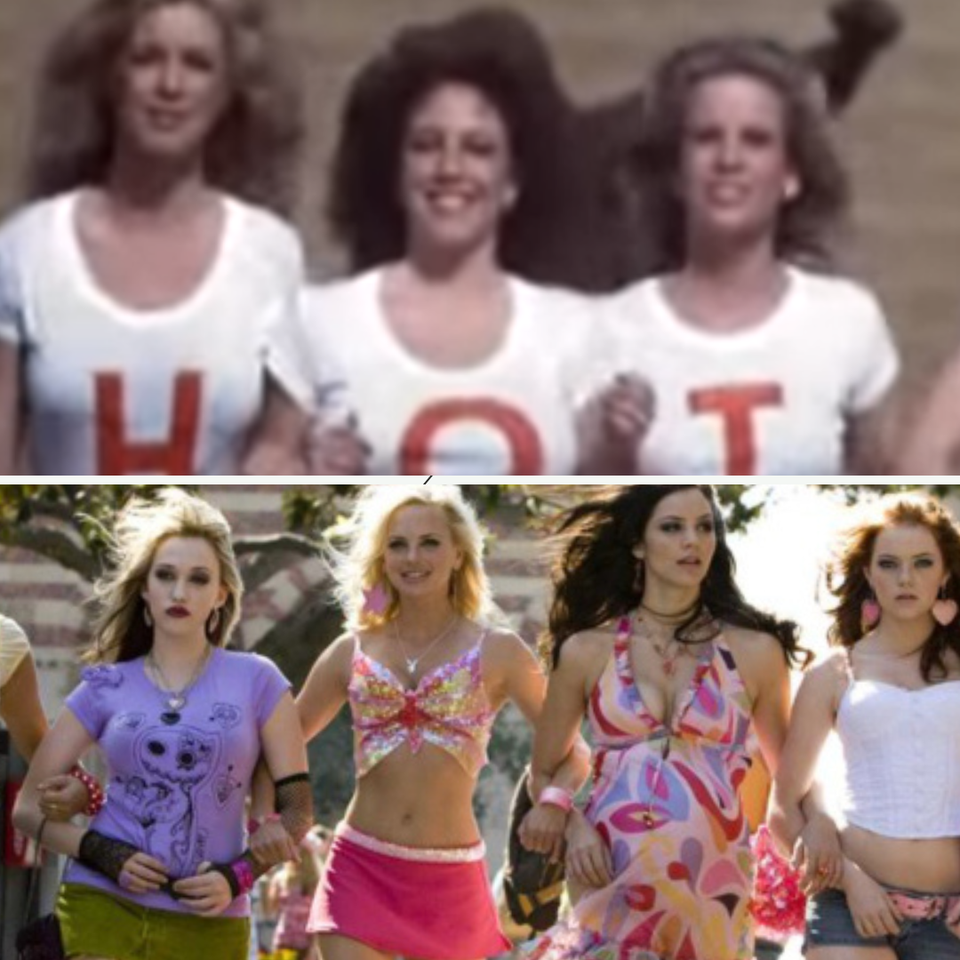
In 1979, a sexploitation film, H.O.T.S., bounced its way into the drive-ins. You might recognize it under its sleazier, better title, T&A Academy. Or more likely as the obvious inspiration for the infamous Hooters uniforms. A shameless ripoff of Animal House, it tells the story from the women's point of view.
The result is a shaggy, raunchy, sexy, jiggly good time. I have fond memories of H.O.T.S. Seeing the VHS cover on the shelf at my local video store kick-started my young imagination in ways that drove me to distraction. Honestly, a movie about a bunch of working-class babes of varying cup sizes sticking it to the rich and prissy sorority bitches was catnip to my younger self. My older self thinks it's swell to.
"Now playing in 42DDD!"
But the strange thing is how H.O.T.S. shares a lot of similarities with another movie made in 2008, The House Bunny. Both films are written by women and directed by men. A fact that makes the success of one and the failure of the other all the more fascinating.
Both movies exist squarely in the middle of the now, outdated, notion of “the male gaze”. The biggest problem with the term “male gaze” is how many try to frame the term as a negative critique rather than merely a critique. In other words, less an observation that has good and bad qualities and instead is seen as a moral evil. The male gaze is neither good nor bad. The male gaze often overlaps with the Queer gaze and vice versa. It’s the institutions and how they wield their power that are harmful.
While the phrase may be on its way out the door, due to our ever-expanding understanding of gender and sexuality, the meat of the term is apt for our purpose.
Both movies serve as examples of movies centered in the male gaze, but in different ways. Except, while one movie finds a way of pushing back while still preening for the gaze, the other stumbles and loses its way, and despite its critiques, almost conforms to it.
H.O.T.S. is a bald-faced cash grab. A movie made for teenagers and college students to get drunk to while ogling the buffet of hooters that wobble across the screen. Boy, does it live up to its promise. H.O.T.S. is a movie tailor-made for melon felons. Even if it didn’t have the pneumatic Lisa London as O’Hara, it still has such a variety of boobs from slightly a handful to characters named “Boom-Boom” (Angela Aames).
Lisa London as O'Hara and her button-busters. I love the Irish!
Despite the unabashed prurience of H.O.T.S., the screenplay by Cheri Caffaro and Joan Buchanan, somehow gives us a sleazy good time while never veering into outright sleaze with a capital “S”. The structure of the script is held together by old scotch tape that’s barely able to hold the film together for its brief runtime, and yet the ladies still manage to smuggle in some heart.
The so-called plot involves Honey (Susan Kiger) and friends vowing to steal the boyfriends of the bitchy Pi sorority after they mock Honey’s failed attempt to pledge their house. The snooty divas also look down on the fact that Honey had to work to afford to go to college. Caffaro and Buchanan waste little time setting the table, as it were, and effectively establishing the snobs versus the slobs' dynamics.
The trope is a time-honored cinematic tradition, but it is deceptively hard to pull off. The balance has to be struck just right in tone because if your slob is too obnoxious, they come off like bullies ala Revenge of the Nerds. In addition, H.O.T.S. lets the girls of Pi sorority be deliciously bitchy while giving them names like Melody Ragmore (Lindsay Bloom).
The real joke is how unserious Honey, O’Hara, and the others treat the initial plan, all but forgetting about it five minutes later. They form H.O.T.S. out of spite, but are too busy having fun to really go through the plan. The stealing boyfriend plot goes nowhere until about halfway through the movie when Honey seduces Melody’s boyfriend, who doesn’t seem all that attached to Melody.
With all the nudity in H.O.T.S., there is only one sex scene, but it's shot tastefully, even erotically. The DP Harvey Genkins and the editor Barbara Pokras work to give the sex scene a rhythm and a tenderness usually lacking in sexploitation films. The sex scene is the most cinematic aspect of the film. Well, until we get to the huddle-cam. The huddle-cam is a point of view shot from inside the huddle of the climatic strip-football game in which half a dozen pairs of jugs hang over the frame as we stare heavenward.
We simply do not make art like H.O.T.S. anymore.
In contrast, The House Bunny is the very model of taste and moralistic messaging. The film hopped into theaters with a stacked cast, though not as stacked as H.O.T.S., though Kat Dennings as the bitchy goth Mona gives the good old college try. However, unlike H.O.T.S., The House Bunny isn’t about trying to capitalize on the latest hit, so much as it comes from an idea that Anna Faris had about what happens to Playboy Bunnies after they leave the Playboy Mansion.
Anna Faris commits so hard to this movie, it's a shame it's not better.
An idea that is worth exploring. To say nothing of Farris is the Goldie Hawn of our era and the perfect fit for the role. But Faris’s idea was too dark for the studios to greenlight, and so Karen McCullah and Kristen Smith were brought on to lighten it up. McCullah and Smith were the same screenwriting duo behind the juggernaut and iconic mega hit of 2001, Legally Blonde. The result is a toothless ‘PG-13’ movie that should have been a toothy ‘R’.
Like H.O.T.S., the thrust of The House Bunny is built on the snobs versus the slobs, with the Phi Lotta Mus versus the Zetas. But the calibration is off. We don’t get enough of the mean girls to really feel the divide. There are a few attempts at class commentary; one of the Zeta girls, Carrie Mae (Dana Goodman) is from a trailer park. But Goodman plays Carrie Mae as a joke, often swinging her arms as she gallops across the screen.
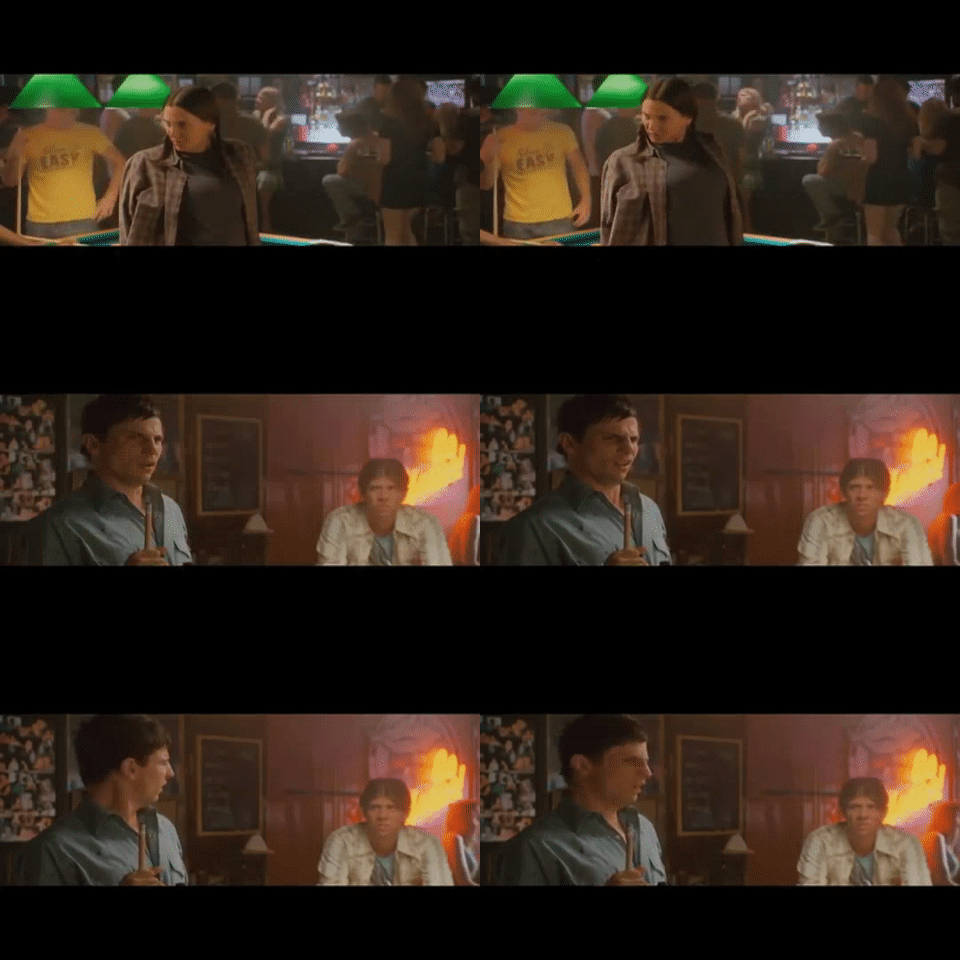
H.O.T.S. has a similar character, Cynthia (K.C. Winkler), but aside from an accent, she behaves like a normal human being. She also makes moonshine in the attic for the H.O.T.S. sorority parties. While H.O.T.S. is far from a dissertation of class, it's also not treating its rural characters as if they are a few steps shy from being fully civilized.
There is a stark contrast in how both films view their women protagonists. Ironically, it’s the 1979 sexploitation film that likes its women characters more than the 2008 Hollywood one. The women of The House Bunny barely like other women, much less Farris’s Shelley.
Now, while Farris may not have the typical physique of what you may picture when you hear the word "bimbo", she has more than enough BTE, gumption, and comedic chops for the role. A good thing too, because whereas Caffaro’s and Buchanan’s script knows exactly what it is, McCullah and Smith’s script has zero clue. Or maybe it did, but once it got caught in the gears of Happy Maddison Productions, Adam Sandler’s production company, it got chewed to pieces. The House Bunny spends its runtime tripping over their feet trying to spread well-intentioned feminist homilies that never land because they can’t figure out what gaze they want to center the story in.
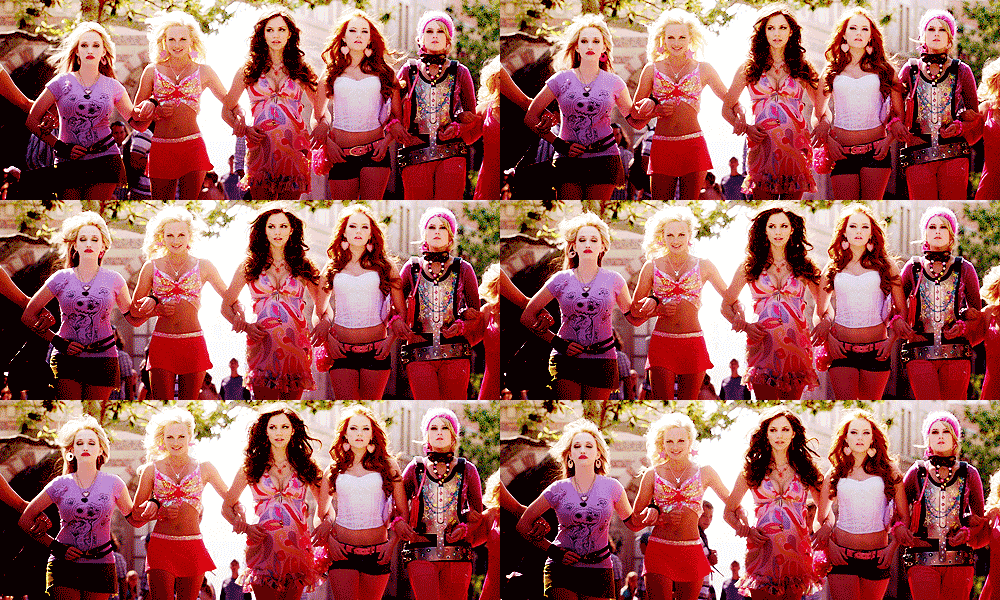
It’s not the male gaze because there’s little to no objectification of the women in the film. But nor is there even any joy in the notion of sex or comfort of the female body, so it's not that feminist either. The girls of The House Bunny are obsessed with boys in a way that the girls in H.O.T.S. are not. For all of the script's attempts to try and parse what modern womanhood looks like, it never goes anywhere because so much of it centers on “How do we attract boys?” (Never mind the missed opportunities at Queer subtext, The House Bunny is depressingly heterosexual and not in the fun way, but in the boring, tragic way.)
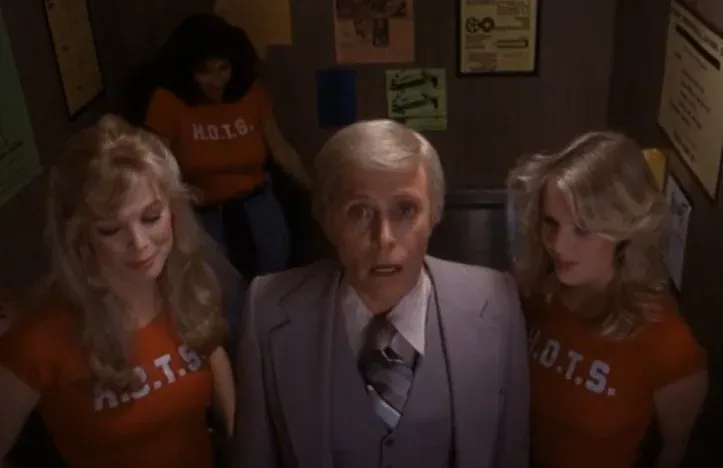
The reason the two movies have such stark differences, besides the obvious eras of which they were made and cultural sensibilities, lies largely with the directors. In the case of H.O.T.S., Gerald Seth Sindell knows his audience. He puts the TITS in titillating. But while Sindell may be wallowing in frat humor, the women seem to be not only the instigators but also welcoming to women of all shapes and sizes.
Yes, there is a fat girl, Clutz (Mary Steelsmith), but for the most part, she is part of the sexual shenanigans with the rest of the girls. Meanwhile, the men in H.O.T.S. are lovable himbos, and are more than happy to help the ladies in their quest to annoy the upper-class prisses at Pi sorority. Sindell never uses the camera to leer and instead uses it as a bemused observer.
At one point, the girls break into a fraternity for a “jock-strap raid,” and unlike other movies where men break into sororities for panty raids, the men seem all but happy to be raided. Sindell and Pokras go the Benny Hill route, speeding up the footage in a montage of the women chasing the men, as the women call the shots and the men happily go along for the ride.
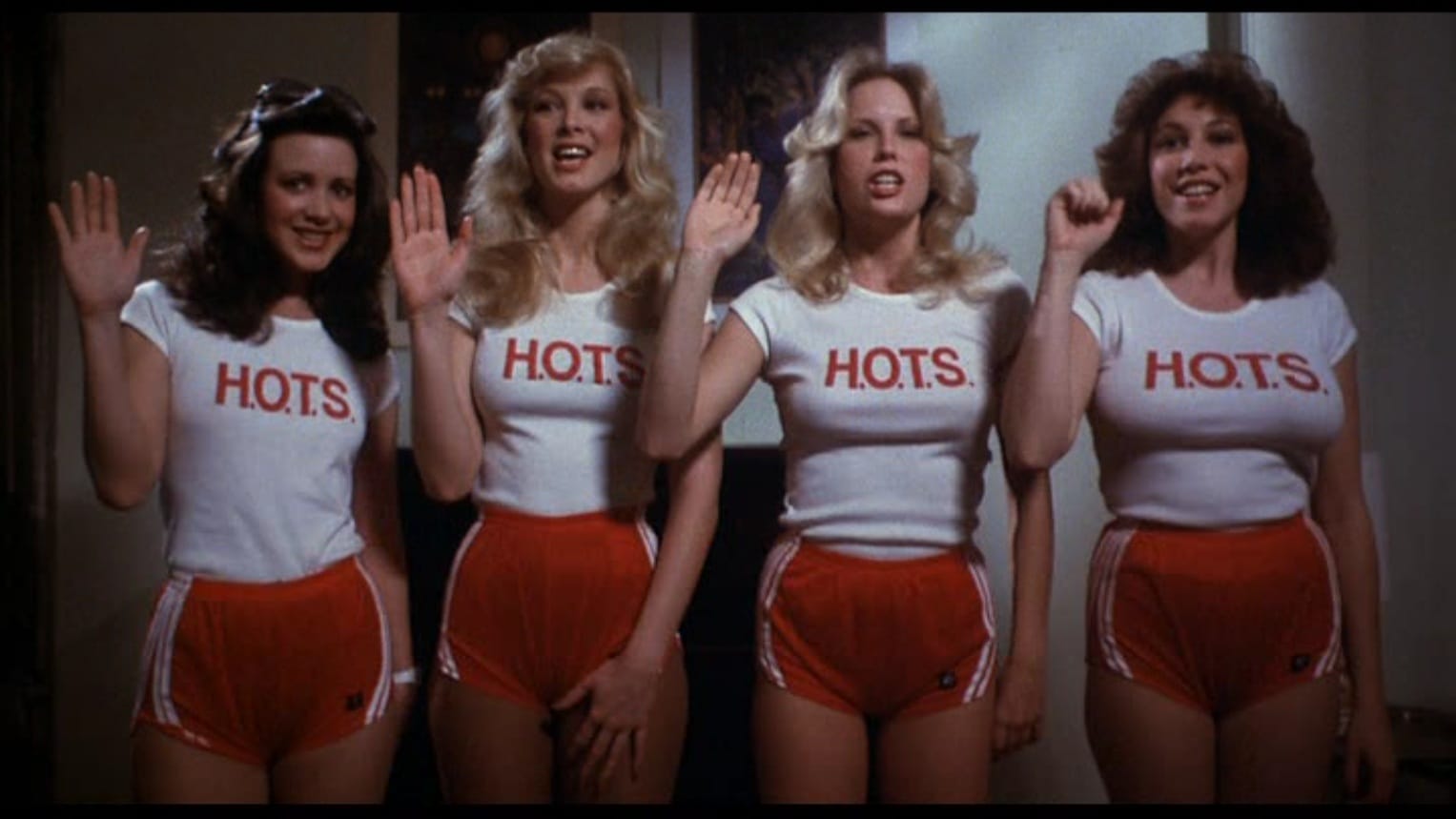
Late in the movie, the dean of the university, Dean Chase (Ken Olfson), becomes sexually aggressive with one of the girls of H.O.T.S. While the scene is filmed as somewhat wacky, it is also filmed in a way that shows the Dean is wrong. The girl fights him off with the help of some of the fraternity bros passing by in a hot air balloon, looking for an escaped bear. (Don’t ask.) The instance is used to blackmail the Dean into leaving the H.O.T.S. sorority alone.
Contrast this to Fred Wolf’s clunky direction of The House Bunny. Within the opening few minutes, Farris’s Shelley makes a joke about being roofied several times. The House Bunny is not only tonally confused, but it has no idea who they are making the film for or why. It has something it wants to say, but no idea how to say it. It can’t figure out if it wants to cater to the male gaze or dismantle it. It fails to do either.
Although directed by a man, H.O.T.S. never feels like it doesn’t like women. On the contrary, rampant bare jiggling gagzongas aside, the 1978 film audaciously views women as just as randy, juvenile, brash, and exhausting as the men. Meanwhile, watching The House Bunny, I kept going back and forth on whether or not the film even liked Shelley.
Wolf’s direction in The House Bunny is somehow sloppier, more incompetent, more juvenile, and plain boring than a 1979 sexploitation Animal House ripoff. While the script is steeped in progressivism and tries to blend bimbohood with modern feminism, it ends up advocating for neither very well. The end feels less like a bid for solidarity and more like a treacly, “Don’t judge a book by its cover”.
To add insult to injury, for a movie advocating for bimbos to be welcomed into feminist thinking, the movie has zero thought about plastic surgery, body autonomy, sex of any kind, or has any actual bimbos in the main cast. Likely, this is due to the film’s ‘PG-13’ rating, because if The House Bunny had the likes of Candy Charms, Denise Milani, or Jordan Carver, the film would be rated ‘R’ simply for the existence of fake boobs. ‘PG-13’ is a watered-down, useless rating that leaves The House Bunny feeling neutered.
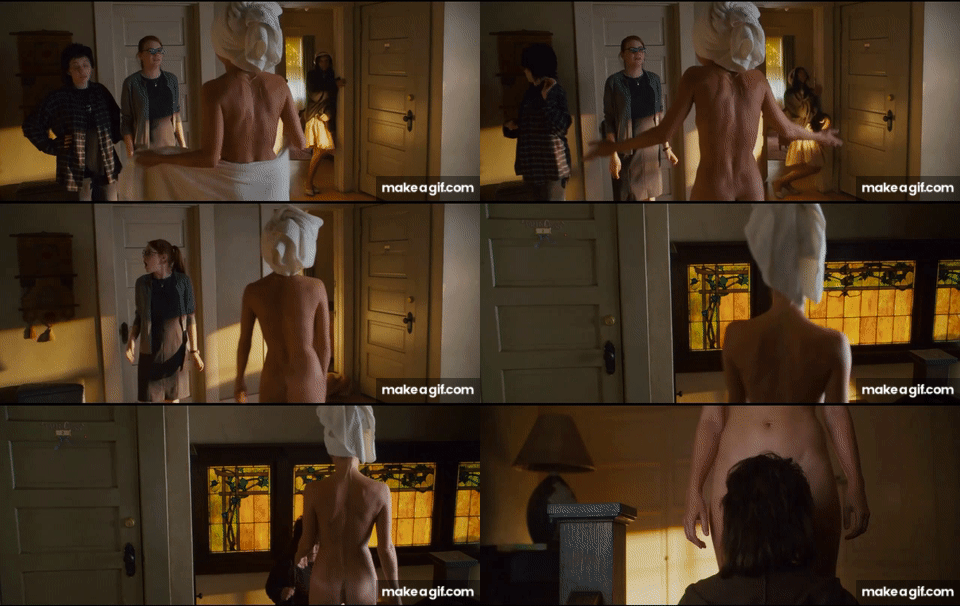
The result is a movie about a Playboy bunny and how bimbo aesthetics can be empowering. Yet, The House Bunny is so terrified of nudity, sex, boobs, and actual bimbos that we’re left wondering what The House Bunny even thinks a bimbo might look like. The House Bunny almost gets Kat Dennings to show cleavage, an aesthetic choice that is baffling to say the least, considering how much of it was on display for “2 Broke Girls.”
At one point Shelley discovers Emma Stone’s Natalie is a virgin. Being a virgin is not a big deal. But the way the movie treats it is downright bizarre. Shelley throws an Aztec party, so they can sacrifice Natalie’s virginity. They throw the party; Natalie jumps into the Jello volcano and slides down the slide, and that is the last that is ever spoken about her virginity. This is the same film that shows the Zeta being grossed out by Shelley's nudity and plastic surgery.
Wolf’s direction brings a frat boy mentality to a script and story that is utterly at odds with McCullah and Smith’s script. Shot by Shelly Johnson, a man, and edited by a woman, Debra Chiate, another shared similarity with H.O.T.S, The House Bunny never once feels like anything but a business favor.
The confused gaze warps the movie, the aesthetic, and the messaging into a weak, half-brained story about nothing. The House Bunny is an ugly-looking movie, whose look is not helped by early 00’s fashion. The makeover reveal of the ladies of Zeta is a wretched eyesore. The clothes fit, sort of, but everything is off; nothing looks sexy or all that comfortable. Not looking sexy is a huge deal, but considering the whole point is that Shelley is a bimbo trying to give bimbo makeovers to her newfound friends, they should look, I dunno, sexy? They look less like bimbos and more like Avril Lavigne, which is fine, but please God, let’s not confuse skater-punk with bimbos.
The House Bunny also tries to convince us that a goth Kat Dennings is repulsive. A truly egregious blunder, considering that among all the girls, Dennings looks like a stacked goddess no matter what outfit she wears. Goth, bimbo, or whatever, Kat Dennings is going to be the center of attention no matter how you dress her up, so stop trying to hide her.

The House Bunny is only ten minutes longer than H.O.T.S., but it feels like a ten-hour miniseries. H.O.T.S., by comparison, with admittedly a few slow spots, flies by. An oddity because the structure of H.O.T.S. is Caffaro and Buchanan throwing everything they can think of into the movie to pad out the runtime, compared to McCullah and Smith trying to craft a narrative with a message inside.
The thing that made McCullah and Smith’s Legally Blonde such an iconic hit is absent here. In Legally Blonde, McCullah and Smith showed how the visual aesthetics of femininity were just that, an aesthetic. What made Elle Woods wasn’t her fashion, it was who she was as a woman and how she treated other women. The House Bunny never even bothers wrestling with the aesthetics, and how society never bothers drilling beneath the surface. The result is a movie that loudly proclaims one thing but visually and narratively shows itself to be terrified of anything remotely feminine.
On the other hand, H.O.T.S. never claims to be about anything. But there’s a solidarity among the sisters, a staunch middle finger to authority, and a feeling of anarchy within the genders that keeps H.O.T.S. from ever feeling staid or patriarchal. Yes, there’s a lot of nudity and sex, and none of it matters to the plot, but despite being framed in the male gaze, H.O.T.S. at least dares to embrace it, because you have to have a clear voice to say anything at all.
Images courtesy of Mid America Releasing, Anchor Bay Entertainment, and Sony Pictures Releasing
Member discussion