
Grip-Framing: The Art of Framing the Cleavage Aesthetic
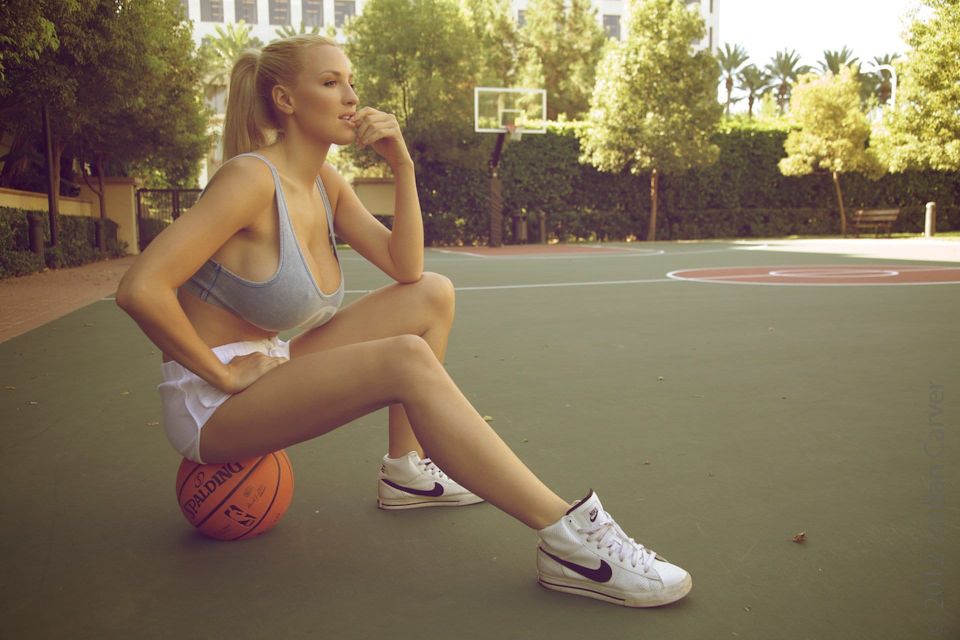
"Ford asked where the horizon was; we ask where the cleavage is." - Anonymous
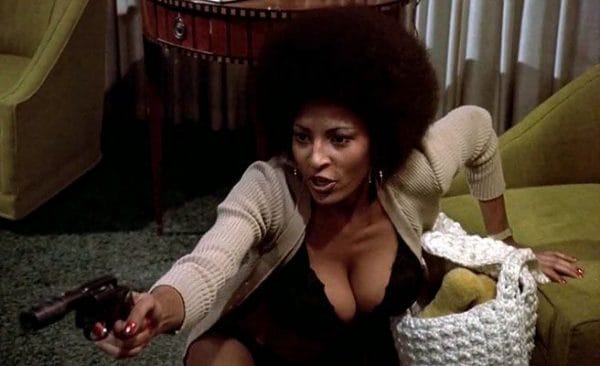
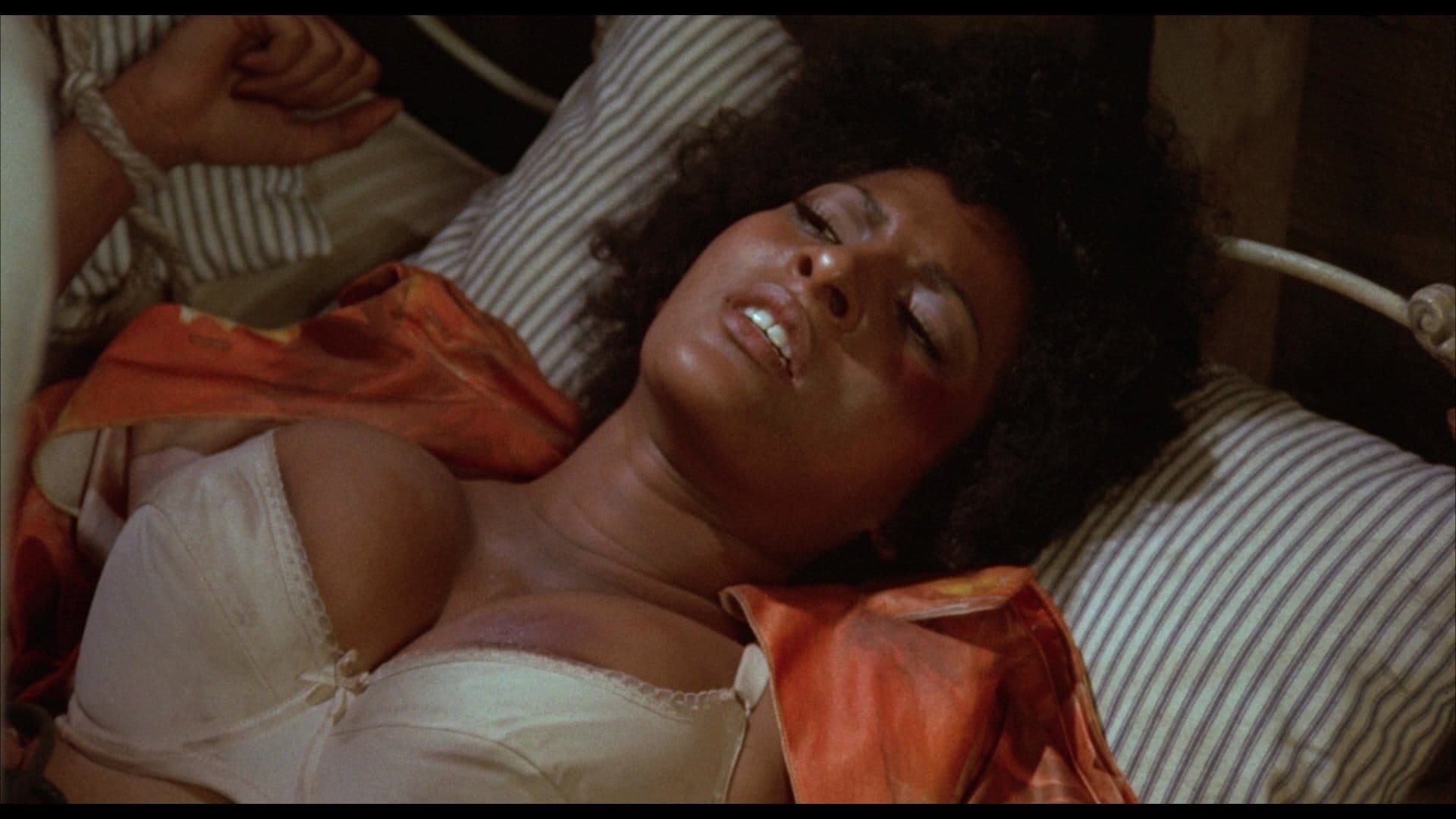
Pam Grier broke barriers and production codes with her mammoth personality. The directors she worked understood, not just her appeal, but what made her stand out amongst her peers in the Blaxploitation genre and often utilized her assets to varying effectiveness.
The biggest misconception about any visual art form is that you simply point the camera and click. There’s a lot of things to take into consideration; lighting matters, angle matters, costuming matters, makeup matters, etc. This is doubly true when trying to make melon felon hooter-ific masterpieces.
I’ve talked about grip-framing before, both in last month’s Gazonga’s Gazette when talking about the rack-tastic Jordan Carver.
Far from objectification, grip framing isn't carving a woman up into pieces. Quite the contrary, it's the model/photographer/director directing you where to look. An offshoot of montage theory, grip framing uses objects within the frame to bring out an added layer of erotic titillation. The best ones find ways to have fun with grip framing. - Excerpt from Gazongas of the Month on Jordan Carver

I mentioned in my original definition that grip-framing isn't objectification. This was a broad statement that isn't strictly true. Grip-framing is most definitely objectification, fun and effective objectification, but objectification nonetheless. For it involves highlighting and crafting the cleavage aesthetic, so in a way it can't not be objectification. However, the collaboration involved in crafting such art, almost by necessity, involves the so-called "object", the model, and thus allows the model to maintain her agency.
If you think I'm overthinking this, I assure you I'm not. Did you think all those gifs of Sydney Sweeney from "Euphoria" just happened? That Sam Levinson and his cameraman set up a scene, concocted a lighting grid, and put makeup on Sweeney, and somehow she didn't realize what they were doing? She knew and, in many cases, was actively involved in crafting the aesthetic using grip-framing.
With grip-framing, the simple act of breathing can become visually arresting. This is also more proof of what I mean when I say Sydney Sweeney uses her whole body in a performance. Most actors would balk at this, but Sydney knows she has breasts and isn't ashamed of them. She knows they give her a visual oomf that other actors don't have and uses them as part of her toolbox.
The above video is a perfect example. Everything about this moment is crafted, planned, and talked about. Sweeney knows where the camera is, where the eyeline is, and thus where her breasts will be in relation, as well as discussing with the costuming department which top has the best design to give her norks the best lift. They use lighting to subtly allow Sweeney's cleavage to glisten, the suspenders highlighting her bust, the toned-down light adding a layer of the maudlin. There are a lot of decisions that had to be made to get this one single, mesmerizing,
But more importantly, notice how her breasts are not dead center of the frame. Too often people assume proper grip-framing means having a hefty set of milkers dead center when in actuality that is often the dullest form of grip-framing. It's easy, lazy, and quite frankly, often comes across flat, even if the model isn't.
Having Sydney's breasts be off to the side, it focuses you on taking in Sydney's melancholy face as well as showing off her impressive side profile. (One of the things that makes Sydney Sweeney so unique is that she actually has a side profile.) She's framed in a way where she is not the only action, but everyone from the costumer to the director has worked to make sure there is a direct path for your eyes to travel.
Grip-framing can be subtle and highlight, like the above Sweeney scene from "Euphoria". Or it can scream and shout, such as James Gunn's "Peacemaker". The second episode of the first season is a prime example of someone having fun with the boldness of grip-framing.

Any other director would have merely cut from Agent Harcourt (Jennifer Holland) in bed to getting dressed. Or done a oner from a distance. But Gunn and his cameraman Michael Bonvillain simply move the camera back a little and to the side. The movement is janky, calls attention to itself, but is also Gunn giving us a pervy smirk. He wants us to see Holland's whole body, as well as capture the natural jiggle of movement.
A true melon felon, Gunn goes above and beyond in making sure to find new and clever ways to grip-frame. What makes this particular instance is the bold, upfront attitude of the framing; the little quick pull back and slide to the left calls attention to the grip-framing. You can feel Gunn smirking behind the camera, winking at the audience.
Holland, likewise, is aware of this because she has to hit her mark, and any time an actor moves, the lighting has to be planned out. Yes, the shot sexualizes Holland, but it also shows Harcourt's personality; she doesn't dawdle. She jumps right into action.
Grip framing can even be found in TikTok. Let's take two examples: 1. The bouncy Paige Spiranac and her killer cans. 2. The impressively stacked Kaelee Renee and her eye-popping knockers.
Image #1
Image #2
Look at Paige in image number 1. She is embodying the cleavage aesthetic while also using grip framing to employ some artful recoil cinema. The camera is stationary, but Paige is at an angle, making sure her delectable cleavage is on unabashed display. Paige isn't wearing a bra, an effort to give her hooters more movement for the swing.
Paige positioned her body and the camera in such a way that you get the full picture of the movement of her knockers. Something worth mentioning because it implies that either she or, with the help of someone else, had to try out different angles, maybe even different tops, to get the desired effect. I mention this to emphasize that grip-framing, indeed the cleavage aesthetic as a whole, seems natural and effortless, but in practice takes a great deal of planning and thought.
Contrast Paige's grip-framing with Kaelee's in Image #2. At first glance, Kaelee appears to be unaware of the assignment. The camera is stationary, but she is facing away, denying us the full force of what must be a truly epic slice of recoil cinema. However, what Kaelee is doing is showing us how vast the sandbox of the art of grip-framing is.
Yes, the camera is stationary behind Kaelee as she shows off a criminally short miniskirt. (Seriously, I highly doubt that's appropriate club wear at any golf club, and if it is, I may have to take up golfing.) But, unlike Paige, Kaelee isn't interested in recoil cinema. Instead, what she does is allow us an unobstructed view of her whole, tight body. The rise of the skirt teases us with the possibility that she's not wearing any underwear, until we see the faint glimmer of red between her thighs.
The twist of her hips highlights her tiny waist, her crop top allowing us to see the muscles and skin stretch during the swing. All of this is a prelude to her focus on the follow-through, which reveals, at the end, a staggering set of golf-club holders. She even pauses, allowing her cleavage to linger in the focal point of the shot, holding the climax, like the echo from the cymbal crash at the end of William Tell's Overture. Far from recoil cinema, Kaelee performed a symphony of teasing.
Far from being a one-trick pony, here Kaelee flips the script. She starts with the focus on her massive knockers and ends on the jiggle of her snare-drum-tight ass. Her cheeks jiggle from the sheer force of the swing. Kaelee is performing a different type of recoil cinema, every bit as effective as the classic style.
Grip-framing need not always be straightforward. Indeed, as shown with Sydney Sweeney's breathing, when it is done with an artistic flair, it hits different. I'm not talking about the sublime joy one gets from watching Colleen Camp's Yvette jiggle across the screen in that fetish-inspiring French Maid outfit. Though, grip-framing like that is an ethereal pleasure all its own.
The opening credits for Barb Wire remain among the best and most exciting credit sequences put to film during the 90s.
The 1996 cult classic Barb Wire is awash in the cleavage aesthetic, with director David Hogan and his cameraman, Rick Bota, taking grip-framing to heights not seen outside of Andy Sidaris or Russ Meyer films. The opening credits serve as an announcement that the film will be dripping with sex, with Pamela Anderson's body acting as a trumpet blare, grabbing the audience's attention by the lapels and shaking us with excitement.
Few songs have been upstaged by a dancer quite like Scottish rock band Gun's "Word Up". While the song sets the mood, it is Anderson's stripper-esque gyrations along with Peter Schink's MTV-esque cuts that give the opening of Barb Wire its pulsating ambiance. The lighting, the sprays of water, and the teasing glimpses of Anderson's exposed silicone-molded hooters have the audience sweating with anticipation long before the movie even starts.
It is also an example of a film writing a check it cannot cash. Hogan and Bota do a Yeoman's work of grip-framing, but they ultimately fail to truly manage to blend the grip-framing beyond surface-level titillation.
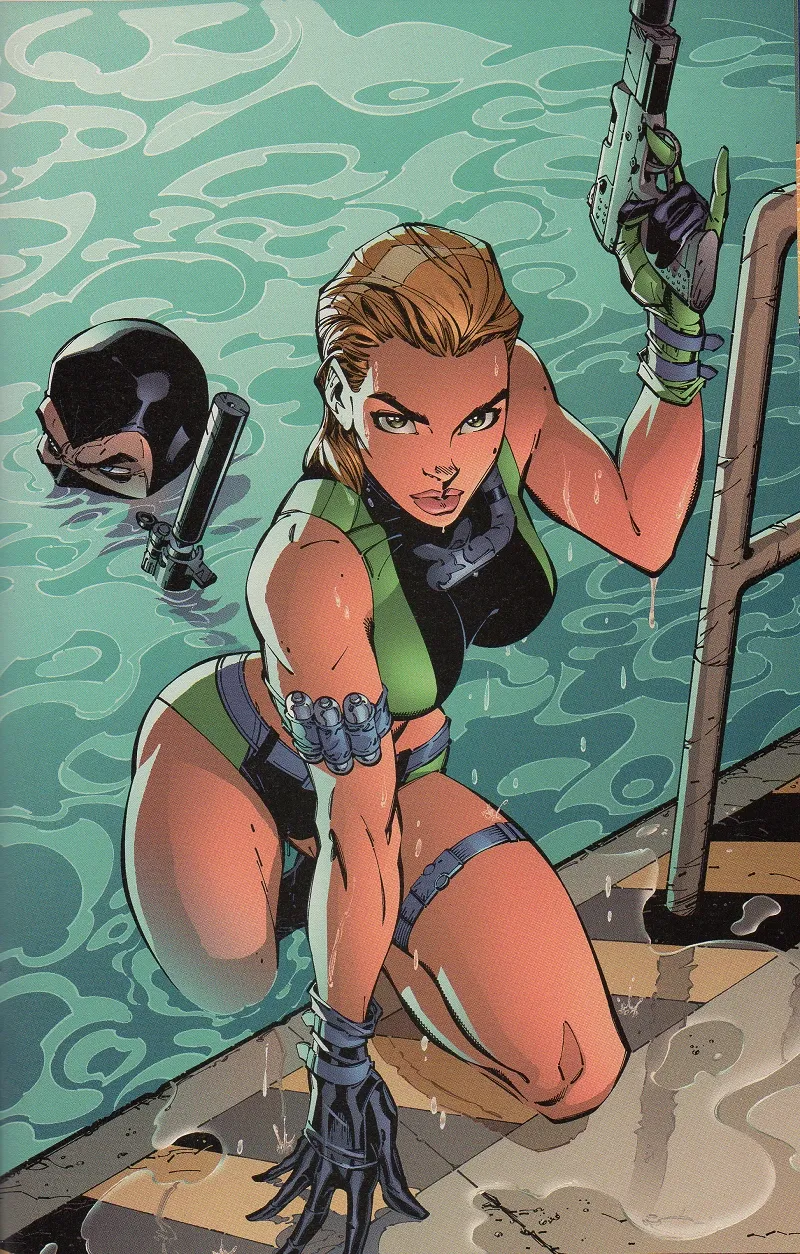
Even in comics, grip-framing never fails to give the story a visual pop. Be it Power Girl, Black Cat, Abby Chase, or Sydney Savage.
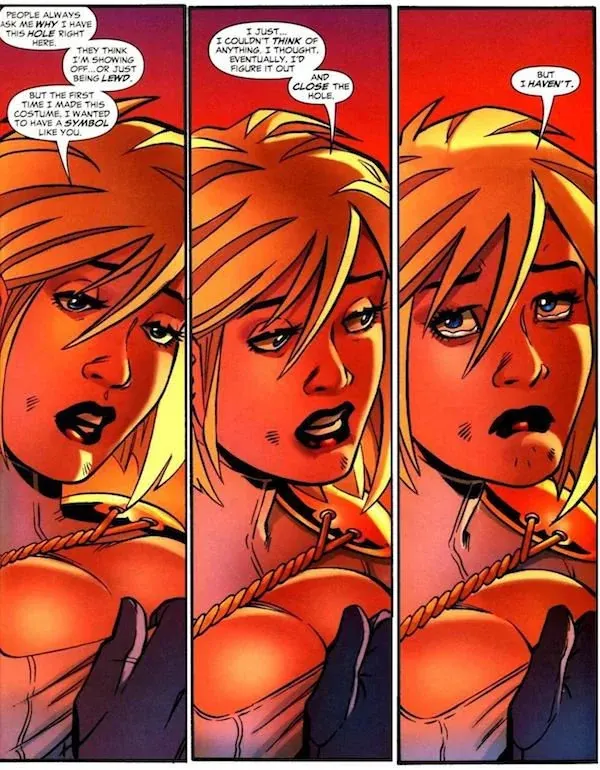
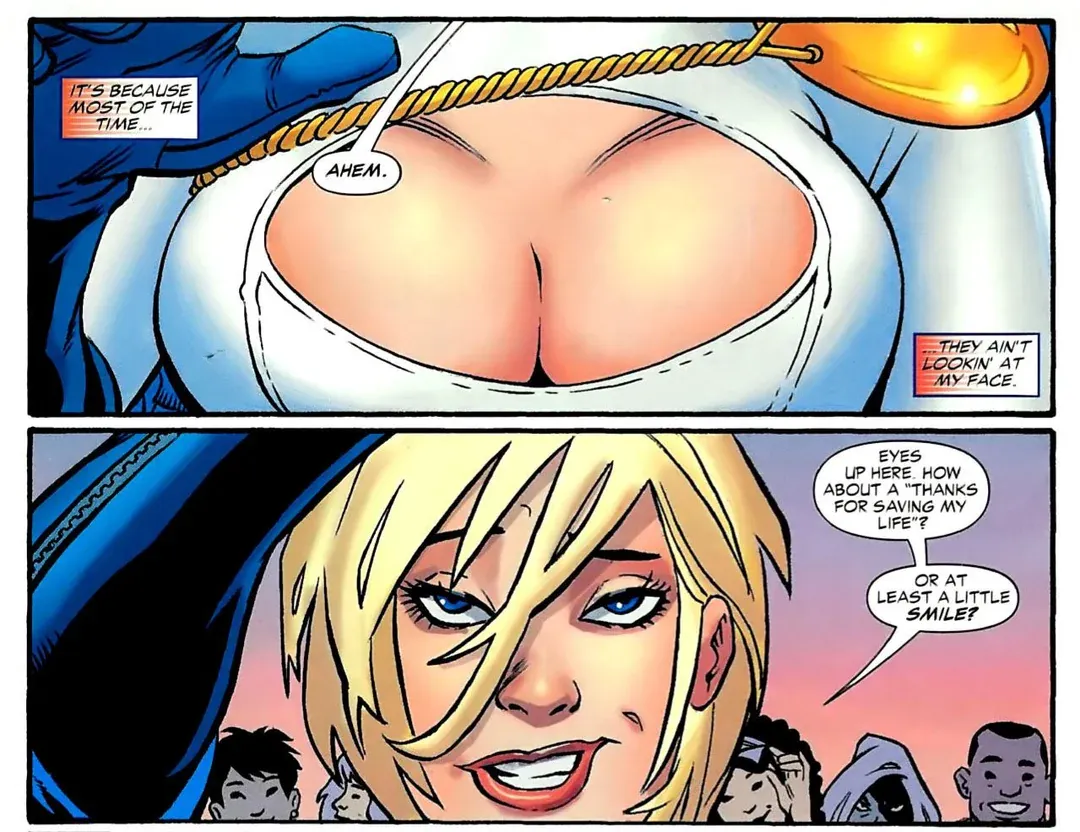
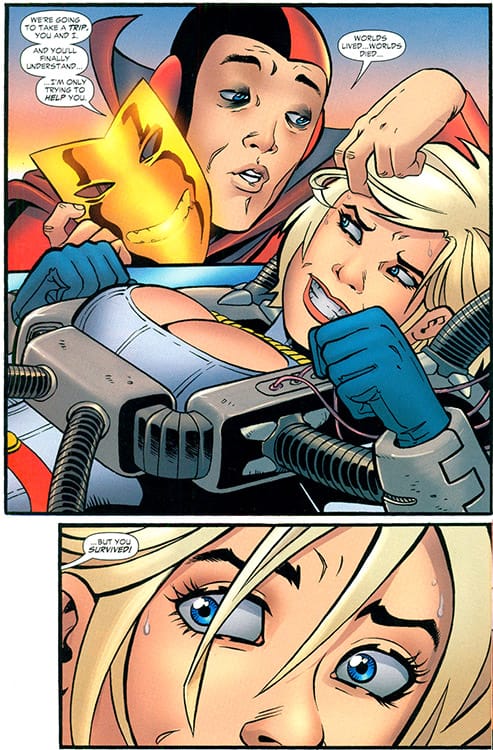
Image#4
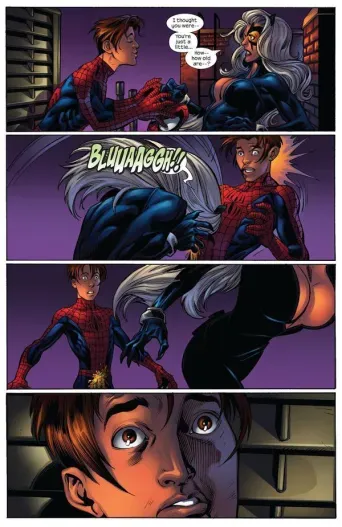
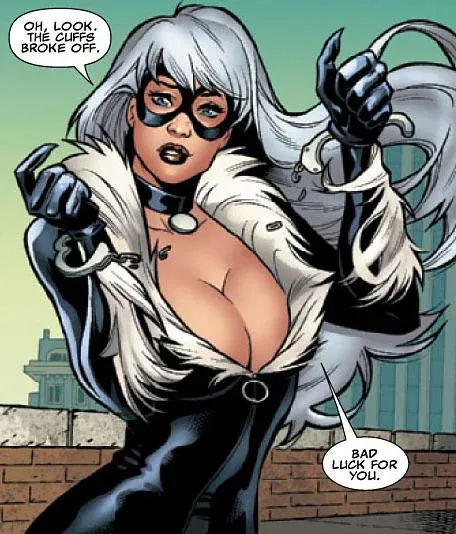
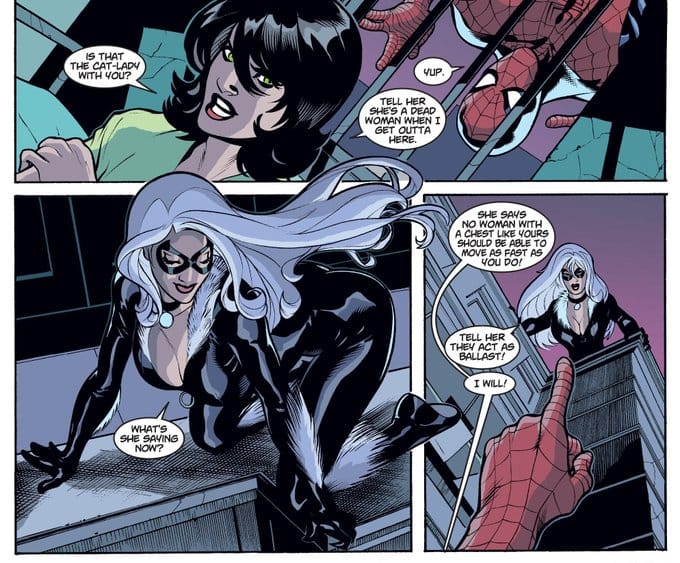
Image #5

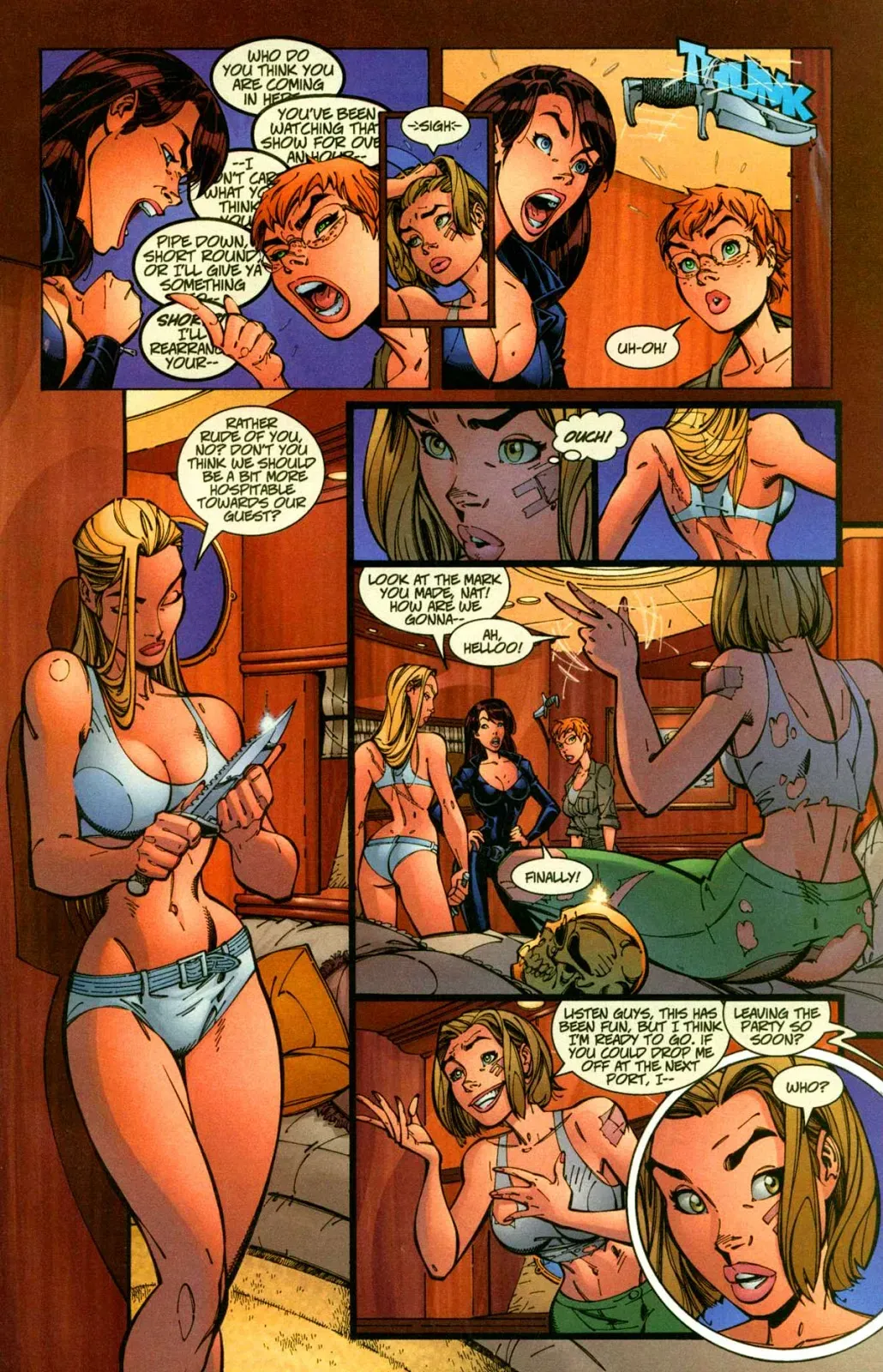
Images #6
Comics, because of their panel format, can either focus on the cleavage aesthetic, as in images 4,5, & 6. Or, as on the last page in image #6, keep it off to the side, as a way to set the mood, akin to a movie's soundtrack. Sometimes, as in images 4 & 5, the focus is borderline burlesque, calling to mind Gunn's framing in "Peacemaker". But as we see in the first couple of pages in image #6, we need not see the melons for the grip-framing to be effective. The faint outline, the hint of their size and heft, is often as titillating and visually arresting as a panel which has its borders strained with a massive pair of juicy fan-service.
Though like the cleavage aesthetic, grip-framing could be applied in a broader sense: arms, butts, and even a man pulling his hair into a ponytail. All of these are a kind of grip framing because all of these have a veneer of performative eroticism about them. Whether it's Sam Elliot pulling his hair back while maintaining eye contact or whether it's Jessica Biel's arms making women and men bite their lips, grip-framing is the brush that gives vibrancy to the aesthetic.
Straight or not, Sam Elliot, maintaining eye contact with you as he pulls his hair back, is a sexuality all its own. You wish you were this cool and hot.
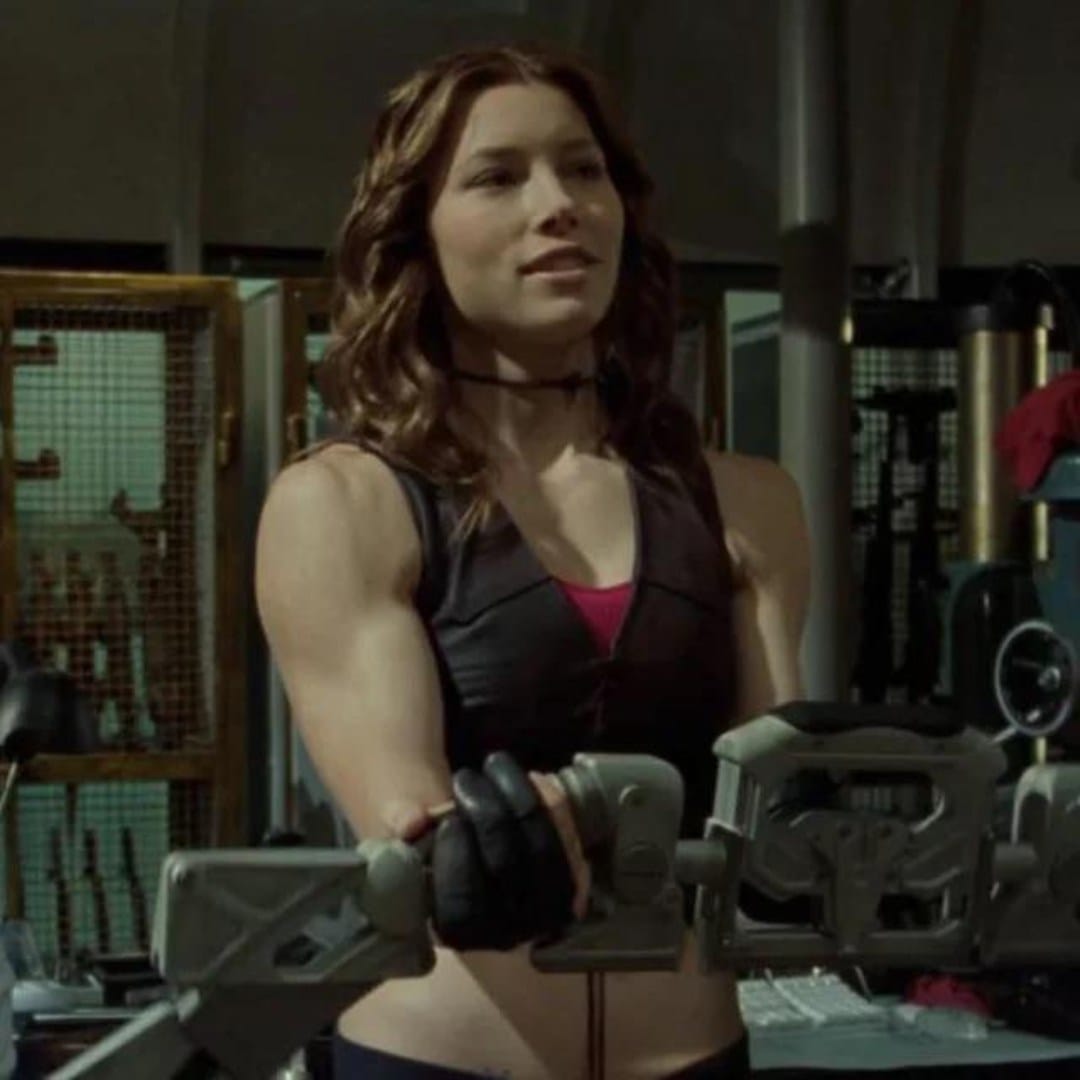
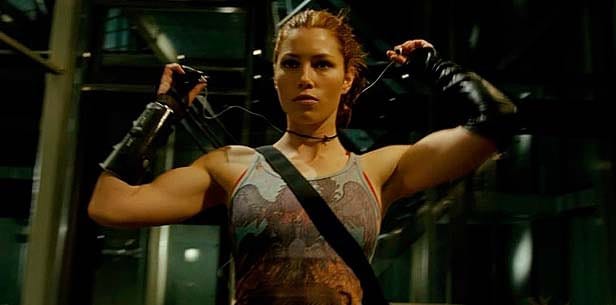
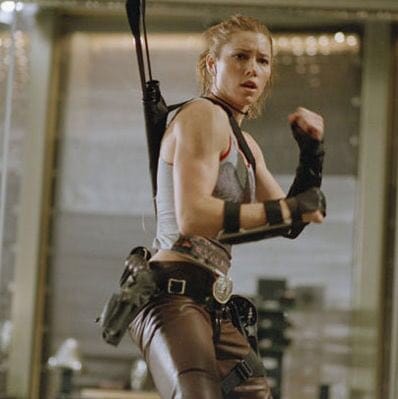
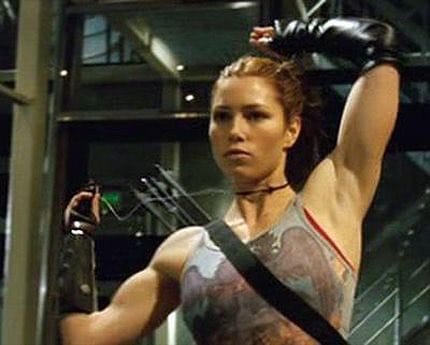
The movie may have sucked. But Jessica's gun show made the film go down a little bit easier.
Heck, Mission: Impossible - The Final Reckoning is dripping with grip framing of every stripe. Christopher McQuarrie may use the Mission: Impossible movies to spread the word of our Lord and Savior Ethan Hunt, but he finds torsos, faces, and mustachioed submarine captains to liven up the film between its awesome action set pieces. Plus, having Katy O'Brian as set dressing is either a stroke of genius or outright cowardice that she's not in the movie more.
Katy O'Brian AND Lawrence Tillman are vying for the most grip-tastic presence.
The problem with so much modern art is how few artists dabble in the cleavage aesthetic or even have the nerve to attempt grip framing, either in the breast-er-ific sense or the wider, more academic sense. Which makes what the little smattering we get now and again feel all the more explosive. But it needn't be that way.
Still, the form is as old as all art. Jack Arnold's camera made use of two special effects in Creature From the Black Lagoon: the creature, and Julie Adams.
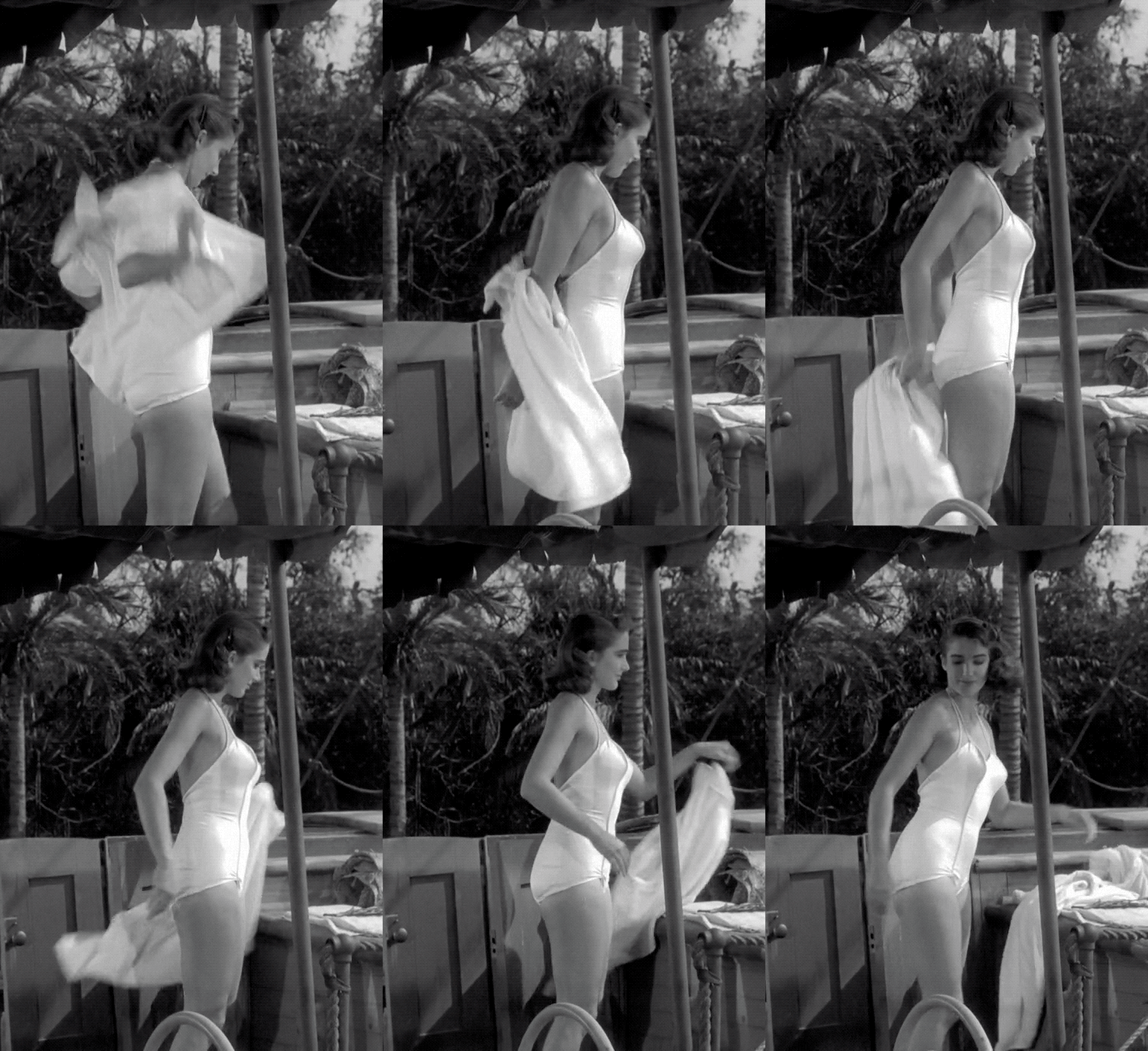
The problem is we have come to associate all art depicting arousal, either subtly or boldly, as pornographic. The mere admittance of desire is seen as TMI or gauche. In reality, it is merely an acknowledgement of what makes us human, of what arouses and excites us. Porn can do that, sure, but art crafted within the cleavage aesthetic with the use of grip-framing feels more alive, whether it be on social media, comics, movies, TV, or whatever. It is natural and a reminder of the pleasures of life during times as trying as these, and feels more important than ever.
Images courtesy of HBO, United Artists, Paramount Pictures, Marvel Comics, DC Comics, Image Comics, New Line Cinema, Gramercy Pictures, and American International Pictures
Member discussion